


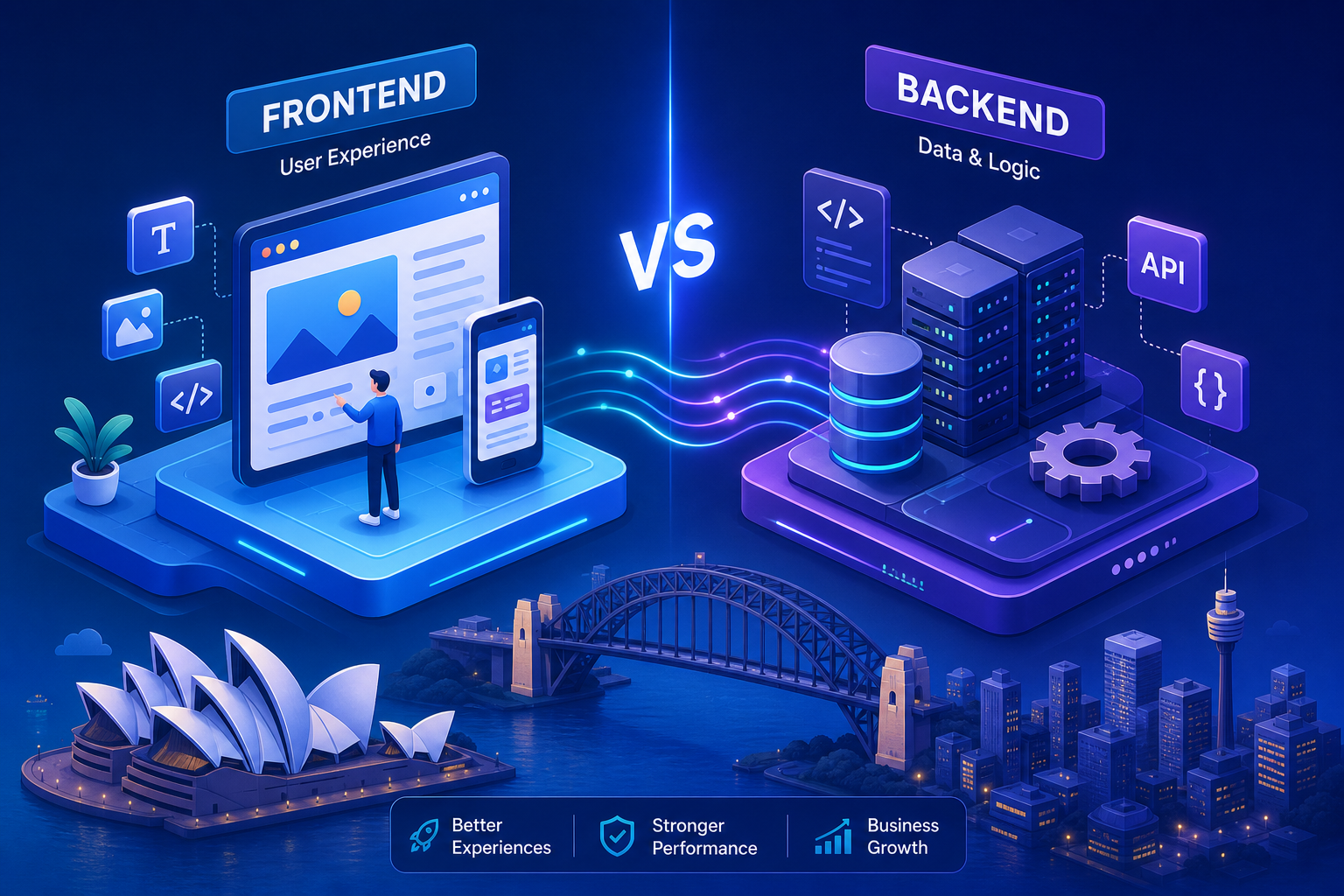
Understand frontend vs backend development for Sydney businesses. Levree explains roles, benefits, and project requirements.
You've got a web project ready to go. You call around for quotes, share a rough brief, and within minutes every developer is throwing around "frontend," "backend," and "full-stack" like these are terms you should already know. They're not explaining them. Nobody does. And by the time the invoice lands, you realise you weren't sure which one you actually needed.
At Levree, we field this exact question from Sydney business owners on almost every discovery call. It's not a gap in your knowledge. It's a gap in how developers communicate. So here's frontend vs backend development explained for Sydney businesses, in plain English: what each role actually does, which one your project needs, what Sydney developers charge in 2026, and how to write a basic brief before your first conversation.
What the frontend actually covers (and what it doesn't)
The layer your customers see, click, and judge you by
Frontend development is everything that renders in a user's browser: the layout, buttons, animations, forms, navigation menus, and the visual hierarchy that guides a visitor toward booking, buying, or getting in touch. This is client-side work, the code that runs on the visitor's machine rather than on your server. It's where first impressions happen, and it's where slow load times directly cost you conversions. Think about the booking form on a Sydney café's website, the "Add to Cart" button on an e-commerce store, or the hamburger menu on a tradie's mobile site. Every one of those elements is frontend work.
What frontend doesn't cover is what happens after someone clicks that button. The data processing, the inventory check, the payment charge, the confirmation email, none of that is frontend territory. The frontend developer hands the baton off at the point of interaction. What happens next belongs to the backend.
Technologies powering frontend work in Sydney
React and Next.js dominate Sydney web projects in 2026. Next.js in particular has become the default choice for anything that needs strong SEO alongside dynamic content, because it handles server-side rendering without requiring a separate backend setup. Tailwind CSS is widely used for rapid design consistency across larger builds, while Bootstrap still shows up in simpler responsive sites where speed matters more than custom flair.
Why does any of this matter to you as a business owner? Because the web development tech stack determines how fast your site feels to users, how easy it is to update content later, and how well the codebase handles traffic spikes. A developer recommending a particular stack isn't just showing off; that decision has a real impact on your long-term running costs and flexibility.
What backend development handles on the other side
The engine room your customers never see
The backend is the server, the database, and all the logic that fires after someone clicks a button. When a customer submits an order on your site, the backend checks available stock, processes the payment through your gateway, fires a confirmation email, and updates your records, all in the time it takes to display a "Thank you" screen. None of that is visible, but all of it can break spectacularly if it's poorly built.
The clearest way to understand the split: frontend is what users experience; backend is what makes the experience actually work. A beautifully designed checkout page is frontend. The logic that securely handles credit card data and connects to Stripe is backend, involving server architecture and API connections that never touch the browser directly. Both need to be solid, but they require completely different skills to build.
When your project has significant backend needs
Not every project is backend-heavy. A static five-page brochure site with a contact form has almost no backend to speak of; form submissions can be handled through a simple email API, and that's about it. But the moment your project involves user accounts, login systems, payment processing, inventory management, or connections to external platforms like a CRM or booking system, the backend becomes the dominant concern.
If your site stores data, retrieves data, or talks to another system, you have a backend project. If it's purely informational with no user interaction beyond a contact form, you're mostly in frontend territory. That distinction shapes your entire budget, timeline, and hiring decision.
Frontend vs Backend Development Explained: How Work Splits Across Common Sydney Business Projects
Frontend-heavy vs backend-heavy: a practical breakdown
Here's how the hours typically split across four project types that Sydney businesses commonly come to us with:
Why this split affects your budget and timeline
Backend work typically bills at a higher rate than frontend because the logic is more complex and the consequences of errors are more serious. A bug in a frontend animation is annoying. A bug in a payment processing flow can lose you money, expose customer data, or both. That risk premium shows up in the hourly rate and in the testing time required to ship confidently.
A project that looks simple on the surface, a product page with a "Buy Now" button, can carry significant backend weight once you factor in the payment gateway, the inventory check, and the order confirmation system. Understanding this before you receive quotes is the single best way to avoid scope surprises halfway through a build.
Full-stack development: one team, both layers
What full-stack actually means in practice
A full-stack developer works across both the frontend and the backend within the same project. They write the React components for your UI and build the Node.js API that powers the data behind it. For small to medium Sydney businesses, a full-stack setup often makes more practical sense than hiring two specialists separately. The codebase stays cohesive, handoffs don't create gaps, and one person understands how a change on the backend ripples into the frontend experience.
This matters more than it sounds. When a frontend developer and a backend developer work for separate companies or freelance independently, coordination becomes your responsibility. You're the one chasing timelines, bridging the communication gap, and debugging the blame game when the API integration doesn't match the UI spec.
If you're evaluating whether to hire a full-stack developer, it's useful to check resources that outline the skills required to become a full‑stack developer so you know what to test for in interviews and technical briefs.
The real cost of splitting frontend and backend across two vendors
When two vendors own different layers of your project, you inherit the overhead of managing both relationships, aligning their timelines, and resolving disputes when something doesn't integrate correctly. That overhead is invisible in a quote but very visible in the final delivery date and total cost. It's one of the most common reasons Sydney business owners come to us having already spent budget with another provider and still not having a working product.
Levree based in McMahons Point in Sydney, operates as a full-stack team that handles both layers under one roof. Sydney business owners deal with one point of contact, one brief, and one accountable team rather than two separate vendors pointing fingers when something breaks. For most projects under the $50,000 range, that single-team structure is significantly more efficient than a split approach.
Frontend vs Backend Development Explained, Hiring in Sydney: Rates and Options
What Sydney developers actually charge in 2026
Sydney commands a 15, 40% premium above national developer averages, driven by demand from fintech, SaaS, and media sector employers. Here's what contract rates look like across the three roles:
Day rates on contract run $700, $1,000, which accumulates fast on a ten-week project. A mid-level full-stack developer at $120/hr working a standard 40-hour week will cost you roughly $4,800 per week before any agency margin. That's the reality of Sydney's market, and it's why many businesses find a local agency arrangement more cost-effective than a direct hire for project-based work.
For up-to-date market context, see Indeed's Sydney front‑end developer salary data and the Morgan McKinley salary guide for front‑end developers in Sydney .
In-house, local agency, or offshore: the honest trade-offs
Each hiring model has a place depending on your project scope and ongoing needs. An in-house hire gives you full control and cultural alignment, but recruitment takes months, salary plus oncosts are substantial, and you pay whether the project is active or not. For most SMBs, that's a significant ongoing cost for intermittent development needs.
A local Sydney agency offers a faster start, same-timezone communication, and a scalable team without the overhead of permanent employment. The day rate is higher than offshore, but the total cost on a defined project scope is typically lower than a full-time salary once you account for leave, super, and downtime. Offshore contractors carry the lowest hourly rate, but timezone friction slows UI feedback loops significantly, and backend integrations with Australian payment gateways or local compliance requirements regularly generate unexpected rework that erodes the initial cost saving. If you're weighing these options, an explainer on in‑house development vs outsourcing is a useful primer on the trade-offs.
How to write a basic developer brief before you call anyone
You don't need a technical background to write a useful brief. Start with the business goal in plain language: what should a visitor be able to do on this site or app that they can't do now? Then list the key user actions, browse products, make a booking, log in, submit an enquiry. Note any systems that need to connect: your CRM, a payment gateway, a booking platform, an email tool. Finally, state your timeline and a rough budget range, even a wide one.
A developer can refine and pressure-test the scope from that starting point. What they struggle to work with is a brief that says "we need a website" and nothing else. The more clearly you describe outcomes rather than technical specifications, the faster the scoping conversation goes and the more accurate your quote will be.
Knowing which layer your project actually needs
Frontend handles what users see; backend handles what makes it work; full-stack covers both within the same codebase and team. For most Sydney SMBs, knowing which layer your project leans on is the difference between a realistic quote and a surprise invoice halfway through delivery. A landing page is a frontend project. An e-commerce store with inventory and payments is a backend-dominant one. A CRM-connected booking system lives mostly in the backend. That mental model alone will make every developer conversation more productive.
If you want frontend vs backend development explained for your Sydney business specifically, Levree offers a free consultation. Bring your idea, even a rough one, and leave with a clear picture of what's involved: which roles are required, what it realistically costs, and who should build it. Book a call with the Levree team in McMahons Point, describe your project, and we'll tell you exactly what it needs before anyone writes a line of code.


Leave a comment
Your email address will not be published. Required fields are marked *