


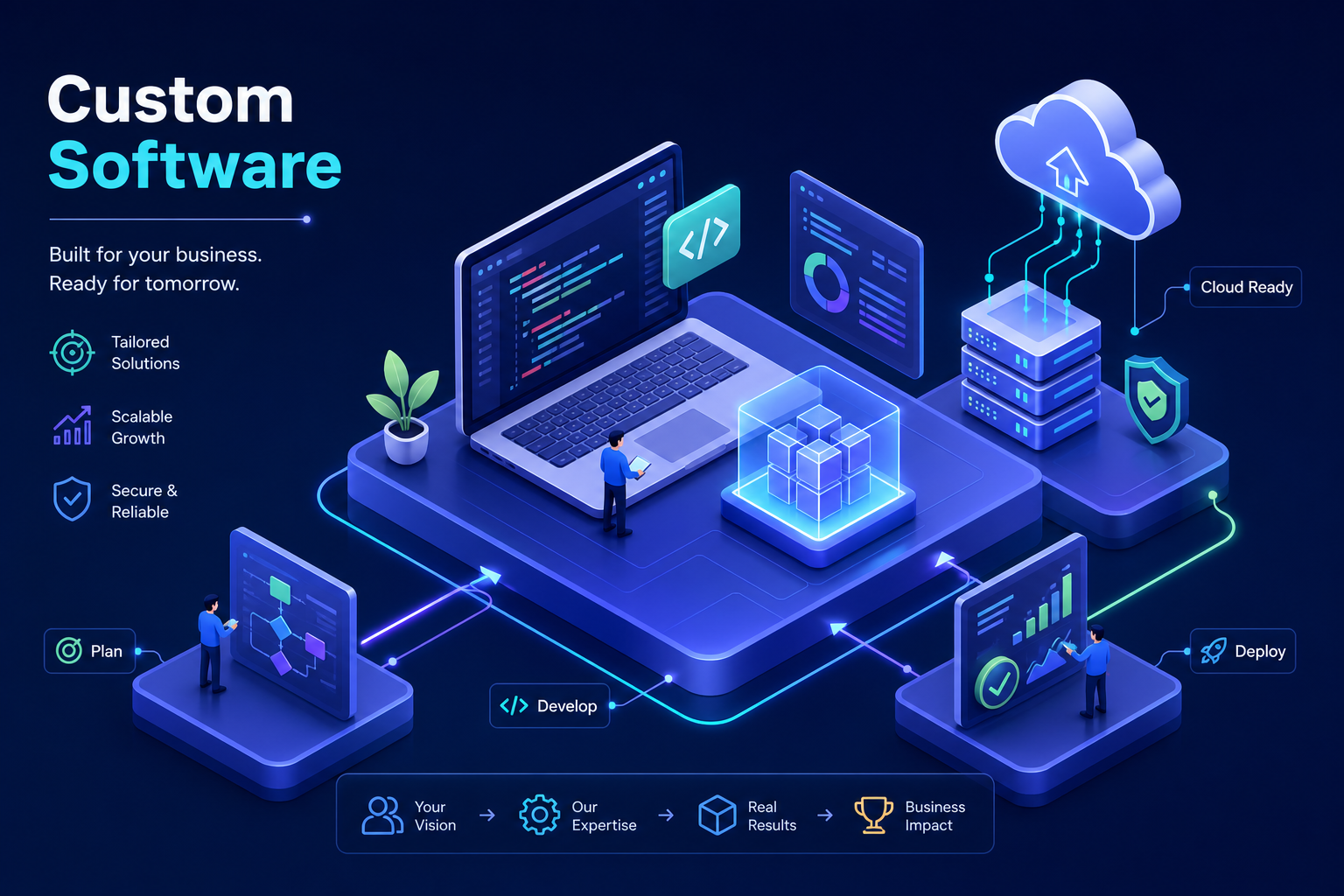
A practical 2026 guide by Levree on custom software development, costs, benefits, and how businesses can scale with the right solutions.
If your team is exporting data to spreadsheets that feed into another spreadsheet, manually copying records between systems that should talk to each other, or working around a platform that was fine two years ago but now limits everything you try to do, you're not alone. This is a common trigger for custom software development, especially as teams outgrow generic SaaS workflows and the workarounds start costing more than the tools themselves. Most growing Sydney businesses hit this wall somewhere between their third SaaS tool and their fifth manual process that nobody's had time to fix. The tools aren't broken. They just weren't built for you.
Bespoke software development used to be the exclusive territory of large enterprises with seven-figure IT budgets. That's no longer the reality. As development costs have become more predictable and agile build approaches have matured, tailored software solutions are increasingly the practical choice for SMEs with specific operational needs that off-the-shelf platforms simply can't meet. At Levree, one of the most common questions we get in our free scoping consultations is simply: do I actually need custom software, or am I overcomplicating this? The honest answer depends on where your current tools are failing you, and what the cost of staying put actually is.
This guide covers what custom application development involves, when the investment makes sense, what a realistic build process looks like, and what it costs in Australia in 2026. If you're already sensing that your tools are working against you, the sections on ROI and project scoping are worth reading first.
What custom software development actually means
Custom software is built specifically around your business workflows. It's not a generic product that you configure or adapt. It's software that starts with your problem and works outward from there, rather than starting from someone else's assumptions about what your industry needs. That's the fundamental difference between a tailored solution and an off-the-shelf platform.
SaaS tools and packaged software are engineered for the broadest possible market. They solve 80% of most businesses' problems well and leave the remaining 20% either unaddressed or managed through workarounds. For some businesses, that 20% is tolerable. For others, it's where their operations actually live. An accounting firm with a highly specific client intake process, a construction company managing multi-site logistics, a healthcare-adjacent provider with strict compliance requirements, these aren't edge cases. They're businesses where generic tools create daily friction that compounds over time.
The types of applications businesses commission vary widely. Internal operational tools that automate manual processes, customer-facing portals and booking systems, scheduling platforms, industry-specific workflow engines, and software integration services that connect existing tools through custom APIs are all common. For teams needing fast, focused wins, we often deliver custom app development scoped tightly around a single high-friction workflow before expanding from there. The tech stack behind these solutions, React, Node.js, Python, .NET, PostgreSQL, matters less than the use case driving the decision. A good development team chooses the stack based on what the software needs to do, not based on preference or habit.
When does investing in custom software actually make sense?
The clearest sign you've outgrown your current tools is when your staff spend meaningful time working around them rather than through them. Data duplicated across systems, no single source of truth, reports that have to be manually assembled from three different exports, processes that should have been automated two years ago but haven't been because the platform doesn't support it, these aren't minor inconveniences. They're operational drag that compounds as you scale. Across our client engagements at Levree, we've consistently seen tailored software solutions cut process time by 20, 30% within the first year. That's not a marginal gain; it's a material business improvement.
The ROI case for custom software development is strongest in industries where standard tools simply can't keep up with operational complexity. Professional services firms with unique client management needs, logistics and construction companies coordinating across multiple sites and teams, healthcare-adjacent businesses navigating compliance requirements, and multi-location retailers with inventory and reporting complexity across branches, these are all industries where bespoke solutions consistently deliver measurable returns. Based on what we observe across engagements and industry benchmarks, well-executed custom builds typically break even by year three when you factor in eliminated licensing fees, reduced manual labor, and workflow automation that generic tools couldn't replicate. For organisations with significant process complexity, we build bespoke enterprise applications where deep integrations and compliance requirements make a purpose-built system the only viable long-term answer.
The question to ask honestly is whether your current tools are enabling your operations or constraining them. If you regularly hear "the system won't let us do that," if your software is dictating your workflows rather than supporting them, or if you're paying for features you don't use while missing the specific functionality you actually need, those are clear signals that the off-the-shelf model has run its course for your business.
Not sure whether a custom build is justified for your situation? Levree free scoping consultation is designed to answer exactly that question, no commitment required.
The build process: from first brief to launch day
Discovery
The discovery phase is non-negotiable. Skipping it causes four to six weeks of delays later and is the single most common reason custom projects go over budget. A proper discovery covers the problem definition, user workflow mapping, feature prioritisation (what must exist at launch versus what can come in version two), tech stack selection, and agreement on success metrics. It's the difference between building what you asked for and building what you actually need. This is exactly what Levree's free consultation is designed to cover, not a sales call, but a genuine scoping conversation to clarify what you actually need before a single line of code is written.
MVP timeline
A standard MVP for a web or mobile-based custom software project takes 3 to 6 months, with a realistic midpoint of around 4 to 4.5 months for most builds. The phase breakdown looks like this: weeks 1 to 2 for discovery and scoping, weeks 3 to 5 for design and prototyping, weeks 6 to 10 for core development, and weeks 11 to 12 for QA and deployment. Production-ready software that goes beyond MVP typically adds another 6 to 12 months of iteration, scaling, and compliance work, depending on complexity. For a practical run-down of common MVP schedules and what to prioritise, see this MVP timeline guide .
Starting lean with a focused MVP is the right call for most projects, the main exception being highly regulated systems that require full compliance architecture from day one. An MVP validates the core concept with real users, avoids overbuilding features nobody ends up using, and gives you actual data to inform version two. Businesses that try to build the complete system upfront consistently face higher costs, longer timelines, and the painful discovery that some assumptions were wrong. An MVP approach keeps risk manageable and keeps the project grounded in real-world feedback.
QA and deployment
QA isn't a final checkbox, it runs in parallel with development from week six onwards. Functional testing, integration testing, user acceptance testing, and security review should all be completed before any production deployment. A development team that treats QA as a two-day sprint at the end of the build is one that's creating post-launch problems you'll pay to fix later.
What does custom software development cost in 2026?
There are three common engagement models. Time-and-materials (T&M) charges for actual hours worked and suits projects with evolving or uncertain scope. Fixed-price works for well-defined MVPs where the requirements are locked before build begins. Dedicated team or retainer models suit ongoing product development where you need consistent capacity over a long period. T&M is the most common model for custom builds because scope shifts once real users interact with early versions, and understanding that upfront prevents friction mid-project when requirements inevitably evolve.
In Australia, agency rates for enterprise software development typically sit between $50 and $300 per hour, with top-tier consultancies reaching higher for large-scale or government projects. For SMB-appropriate projects, expect to budget between AUD $100,000 and $250,000 for a production-ready solution with standard features. A low-complexity build starts around $60,000. Complex, integration-heavy systems can reach $250,000 or more. It's worth noting that Australia's R&D Tax Incentive can offer up to 43.5% in refundable offsets, which meaningfully reduces the effective cost for eligible projects. For more context on regional pricing and typical Australian cost bands, see this analysis of software development costs in Australia .
The single biggest cost control lever a client has is a clearly scoped brief. Vague requirements at the start translate directly into budget overruns mid-project. The key cost drivers are the number of third-party integrations required, user role and permissions complexity, compliance requirements such as data privacy regulations, and whether the development team is local, nearshore, or offshore. If you're considering offshore resource models as a cost lever, this guide to average hourly rates for offshore development can help set expectations. Businesses that invest in proper discovery and detailed scoping before development begins consistently come in closer to budget than those who start with a rough idea and figure it out as they go.
Integration and security: the risks most briefs don't address
Most businesses don't start from a blank slate. They have an existing CRM, an accounting platform, maybe a legacy system that's been running for a decade. Connecting bespoke software to these systems through APIs is where projects get complicated. Outdated API documentation, backwards-incompatible third-party updates, and data silos that force expensive middleware workarounds are the most common problems. These middleware workarounds can inflate integration costs by up to 40% when they're not anticipated in the original scope. For a practical overview of common integration pitfalls in cloud projects, see this guide to common cloud integration challenges .
A good custom software provider designs a buffer layer between the core product and third-party APIs. This isolates the core system from external changes so that when a third-party platform updates its API, the fix is contained to the buffer layer rather than requiring changes throughout the whole application. This architecture decision is rarely discussed in initial briefs but has a significant impact on long-term maintenance costs and system stability.
Security needs to be baked into the architecture from day one, not added as an afterthought at the end of the build. Enterprise-grade custom applications require zero-trust access models, end-to-end encryption, and compliance with relevant data privacy regulations built into the system design. When evaluating any development partner, ask directly: how do you handle security audits, and at what stage does compliance review happen? If the answer is vague or deferred to "after launch," treat that as a genuine red flag. Security retrofits are expensive and often incomplete.
How to scope your project and take the first step
Before contacting any development team, you should be able to articulate four things: what problem this software is solving, who will use it daily, what success looks like at six months, and what existing systems it needs to connect with. These answers don't need to be polished. But having them in rough form means the first conversation becomes a productive scoping session rather than a generic briefing where the vendor has to ask basic questions you could have answered beforehand.
A proper RFP or project brief should include your company background, specific measurable goals, in-scope versus out-of-scope boundaries, technical requirements and integration points, and your budget range. Leaving budget out of the brief is a common mistake that wastes everyone's time. A well-prepared brief shortlists vendors more efficiently, produces more comparable proposals, and significantly reduces the risk of scope disputes once the build begins.
Levree offers free scoping consultations specifically designed for this stage, helping Sydney businesses clarify their custom software development needs, understand what's realistic within their budget, and decide whether a full custom build or a phased MVP approach is the right starting point. No commitment required, no offshore handoff. The team is based in McMahons Point, Sydney, and works directly with clients from brief through to launch. The goal isn't to sell; it's to give you enough clarity to make a confident, informed decision about your next step.
Making the right call for your business
Custom software development isn't the right answer for every business. But for businesses with specific workflows, integration needs, or operational bottlenecks that off-the-shelf tools genuinely can't solve, it's often the most cost-effective long-term investment once you account for eliminated licensing costs, reduced manual labor, and the compounding efficiency gains that automation delivers over time.
You now know what custom software development involves, the operational signals that indicate the investment is justified, and what a realistic build looks like from discovery through to launch. If you're weighing whether a bespoke solution is the right move for your business, Levree's free scoping consultation is where that conversation starts, no jargon, no obligation, just clarity on what's possible and what it would take to get there. Book your free consultation today.


Leave a comment
Your email address will not be published. Required fields are marked *