


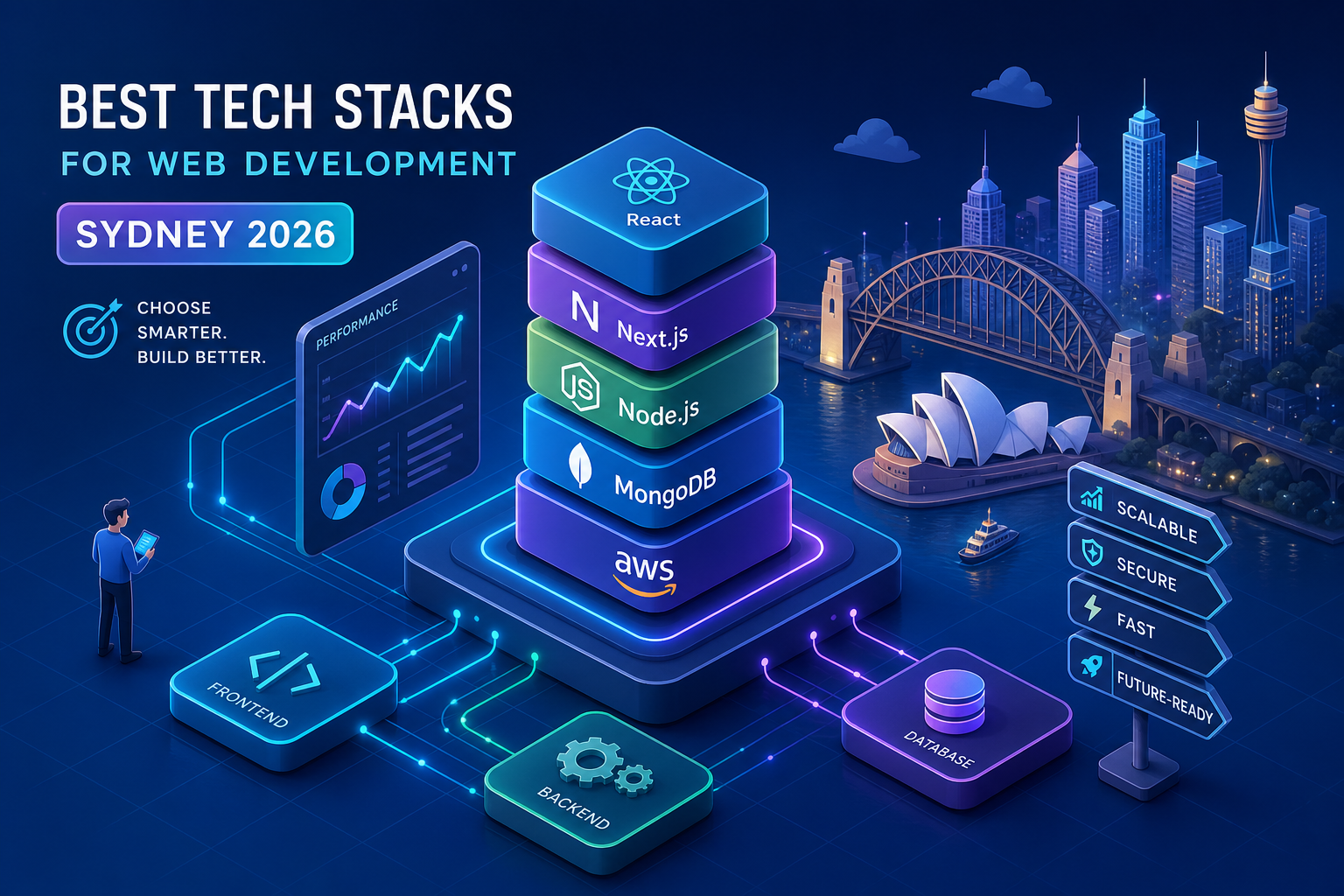
Compare the best tech stacks for web development in Sydney in 2026. Levree helps businesses choose the right technology.
You ask three Sydney developers what stack to use for your new web project. One says React and Node.js. The second recommends MEAN. The third pitches LAMP with WordPress. No one explains why. You're left with three quotes, three acronyms, and zero clarity.
Picking the wrong stack in 2026 costs more than the initial build. It shapes who you can hire in 18 months, how your hosting bill grows, and how painful it becomes to add a feature or bring on a second developer. This guide compares the best tech stacks for web development in Sydney in 2026 to help you choose the right foundation for your hiring plan, hosting budget, and long-term growth. It covers the four stacks Sydney developers are actually building with, maps each one to specific project types, and gives you a three-step checklist to make a confident call. The Levree team is Sydney-based and works across all the stacks covered here, so the perspective is practical, not theoretical.
Why the stack decision matters more than most Sydney businesses realise
The stack you choose at the start of a project locks in three things most business owners don't consider until it's too late: who you can hire, what you'll pay to host it, and how much it costs to change direction. These aren't abstract concerns. They're real budget and timeline risks that surface six to twelve months into a project.
Sydney's developer market skews heavily toward JavaScript ecosystems. Based on aggregated Seek and LinkedIn listings reviewed in early 2026, React and Next.js appear in over 70% of Sydney web developer job postings . That concentration matters because building on a niche or aging stack narrows your hiring options fast. A React developer is straightforward to find on Seek. A Ruby specialist or a legacy PHP developer is a much harder search.
Tech stack choice locks in your hiring options from day one
The hiring pool for React and Node.js in Sydney is deep. If a developer leaves your project midway, finding a replacement on a mainstream stack is typically a matter of days rather than the weeks-long search a niche framework demands. Choose a less common stack, and you're competing for a shrinking group of specialists, often at a premium rate. Seek and LinkedIn listings confirm this: React and Next.js postings dominate full-stack listings in 2026, with 500-plus aggregated postings skewing firmly toward the JavaScript ecosystem.
The gap between launch cost and long-term maintenance cost
A shared LAMP hosting setup can look attractive at $20 a month. But when the site needs custom functionality, a second developer, or a framework upgrade, that initial saving evaporates fast. Cloud-native JavaScript stacks on AWS or GCP often cost more upfront but scale predictably and support a far larger pool of developers who can maintain the codebase without a steep ramp-up period. That's the trade-off to understand before signing any developer contract.
Best tech stacks for web development in Sydney (2026): a quick comparison
React and Node.js: why this combination dominates Sydney projects
React paired with a Node.js backend, typically via Express or Next.js for full-stack deployment, is the clear default for most modern Sydney web projects. TypeScript is now widely adopted in this stack, which reduces runtime bugs and makes codebases easier to hand off between teams. The npm ecosystem is enormous, Vercel and AWS Lambda integrate cleanly, and the local talent pool is unmatched. Next.js adds server-side rendering and built-in SEO tooling out of the box, which matters directly for ecommerce and content-heavy apps where search rankings drive revenue.
MEAN stack: when MongoDB and Angular still make sense
The MEAN stack (MongoDB, Express, Angular, Node.js) is a coherent all-JavaScript option that suits teams wanting a single language across the entire stack. Angular has a steeper learning curve than React but fits structured, enterprise-style applications well. MongoDB's flexible schema is useful when the data model is still evolving in the early stages of a product. It's not the first recommendation for most Sydney projects in 2026, but it's a solid fit for teams already invested in Angular or building internal tools for larger organisations.
LAMP stack: still alive, but know the trade-offs
LAMP (Linux, Apache, MySQL, PHP) powers a significant portion of the web, including most WordPress and legacy CRM deployments, and has an enormous support community. For new Sydney builds in 2026, it's rarely the first recommendation unless you're extending an existing PHP system or the client specifically needs WordPress. The scaling ceiling is lower than cloud-native JavaScript stacks, and bridging PHP's server-side rendering with modern JavaScript frameworks adds complexity that often outweighs the cost savings from cheap shared hosting.
JAMstack: the right tool for content-heavy and marketing sites
JAMstack (JavaScript, APIs, Markup) delivers pre-rendered pages via edge CDN, which translates to fast load times and near-zero backend cost at low traffic volumes. For marketing sites, landing pages, and content platforms, it's genuinely hard to beat on performance and hosting cost. The honest limitation: it's not suited to complex, stateful applications or real-time features without adding significant backend infrastructure, which largely negates the simplicity advantage that makes JAMstack attractive in the first place.
Matching the right stack to your Sydney project type
SaaS platforms, ecommerce, and custom web apps
For high-investment builds, React with Next.js is the default, and PostgreSQL is the preferred database for multi-tenant SaaS due to its row-level security features. For ecommerce, the Next.js plus headless CMS combination is increasingly standard across Sydney agencies: it delivers the SEO benefits of server-side rendering alongside the flexibility of a decoupled content layer. The rationale is as much about hiring as technical performance. A Next.js and Node.js codebase is far easier to staff, hand off, and maintain over time than a custom PHP or Python-only backend.
MVPs, real-time tools, and content-driven sites
For MVPs, the MERN stack or Django combined with React gives you the fastest path from idea to a live product. Both have large communities and abundant tooling for rapid prototyping; for small-scope MVPs with experienced teams, a functional build is often achievable in two to four weeks. For real-time and collaboration apps, booking tools, dashboards, live feeds, Node.js with Socket.io and Redis is the proven combination in the Sydney market, scaling cleanly from early users to high concurrency. For content and marketing sites, JAMstack with Next.js or Nuxt.js deployed on Vercel is the fastest, most cost-effective option that stays fully SEO-friendly.
What it actually costs to hire Sydney developers across these stacks
Salary benchmarks for the most in-demand Sydney stacks
React.js roles in Sydney average $135,000 to $140,000 annually in 2026, with TypeScript seniors reaching $139,000 or higher. Node.js roles in startup environments average around $87,500, with senior positions pushing $140,000 to $160,000 at larger firms. Full-stack developers combining React, Next.js, TypeScript, and Node.js command the top of the salary band, typically $140,000 to $170,000. The most hireable stacks are also the most competitive on salary, so budget for both the build and the ongoing team cost before committing to a direction.
Contractor rates and what they mean for project budgets
Senior React and Next.js contractors in Sydney run $70 to $110 per hour depending on specialisation, with full-stack developers adding serverless expertise (AWS Lambda, Vercel) pushing toward the top of that range. Eastern Europe-based contractors with equivalent skills are available at $40 to $60 per hour, a legitimate option for distributed teams provided you factor in timezone overlap and communication overhead. For a Sydney-based project, mixing a local tech lead with remote contractors is a common and effective cost optimisation strategy.
Cloud hosting in Australia: what Sydney teams use and what it costs
AWS, Azure, and GCP: which cloud suits your Sydney project
All three major providers have AU-East (Sydney) regions, and all deliver sub-50ms latency for many standard web application configurations. AWS is the most widely used for SMBs and startups, with mid-tier web apps typically running $150 to $400 per month. Azure dominates enterprise and government work, particularly following a major Australian government cloud agreement in 2026, with costs typically $200 to $500 per month on reserved instances. GCP is cost-competitive for data-intensive or ML-adjacent applications at $100 to $300 per month for similar workloads. For most Sydney SMBs and startups, AWS is a common and well-supported default, though Azure and GCP offer compelling advantages for specific workloads.
When Vercel, Netlify, or a managed platform is the smarter call
Vercel and Netlify are the right choice for JAMstack projects and smaller teams. Fast deploys, zero config, and free tiers work well under 10,000 visits per month. The cost ceiling matters though: at scale, bursty serverless costs and function invocation limits make them less competitive than AWS or GCP for high-traffic or stateful applications. The stack and the hosting are a package decision. If you're committing to JAMstack, budget for the moment when the Pro tier no longer makes economic sense and have an AWS migration path ready before you hit that ceiling. For Australian-focused managed hosting comparisons, see the roundup of best VPS hosting in Australia for options that prioritise local infrastructure.
A 3-step checklist to pick the right stack and move forward
Step 1: define your project type and your 12-month scale target
Before comparing any stacks, answer two questions: what does the app actually do, and how many users do you expect in year one? A marketing site for a 10-person firm has completely different requirements than a SaaS platform targeting 5,000 active users. Once you know the project type, the matching recommendations above give you a clear, specific starting point rather than a list of possibilities to weigh indefinitely.
Step 2: check developer availability and your actual hiring plan
Run a quick search on Seek or LinkedIn for your preferred stack plus "Sydney." As a practical heuristic, fewer than 50 active listings suggests the hiring pool is thin and recruitment will take longer. Factor in whether you're hiring permanently, contracting locally, or working with a development agency. The stack decision should be grounded in your actual hiring reality, not in what sounds technically impressive or what a single developer happened to recommend in a quote.
Step 3: get a technical review before you commit
The most expensive stack mistake is one made in the first two weeks and discovered six months later. A one-hour consultation with a local full-stack team before finalising the decision can prevent months of costly rework.
Levree Sydney-based team works across React/Node.js, MEAN, JAMstack, and modern JavaScript frameworks. If you've worked through steps one and two and still feel uncertain about the right direction, a free initial consultation is available to help you reach a clear recommendation. Book at levree.com before you sign any developer contract.
Which tech stack should you choose for web development in Sydney in 2026?
There is no single best tech stack for web development in Sydney in 2026, only the right one for the specific build, budget, and team behind it. That said, Sydney's developer market makes the React and Node.js ecosystem, often built with TypeScript, Next.js, and cloud hosting on AWS or GCP, the most practical default for most projects. The talent pool is deep, the tooling is mature, and the hosting options are well-established and predictable.
The stack sets the foundation, but execution and ongoing support matter just as much. A well-chosen stack built poorly will still cause problems. A less fashionable stack built and maintained by a strong team will outperform it. If you're finalising a technology decision for a new build or site rebuild, Levree offers a free initial consultation to help Sydney businesses choose the right foundation from the start. You'll walk away with a specific recommendation based on your actual project goals. Reach out at levree.com


Leave a comment
Your email address will not be published. Required fields are marked *