


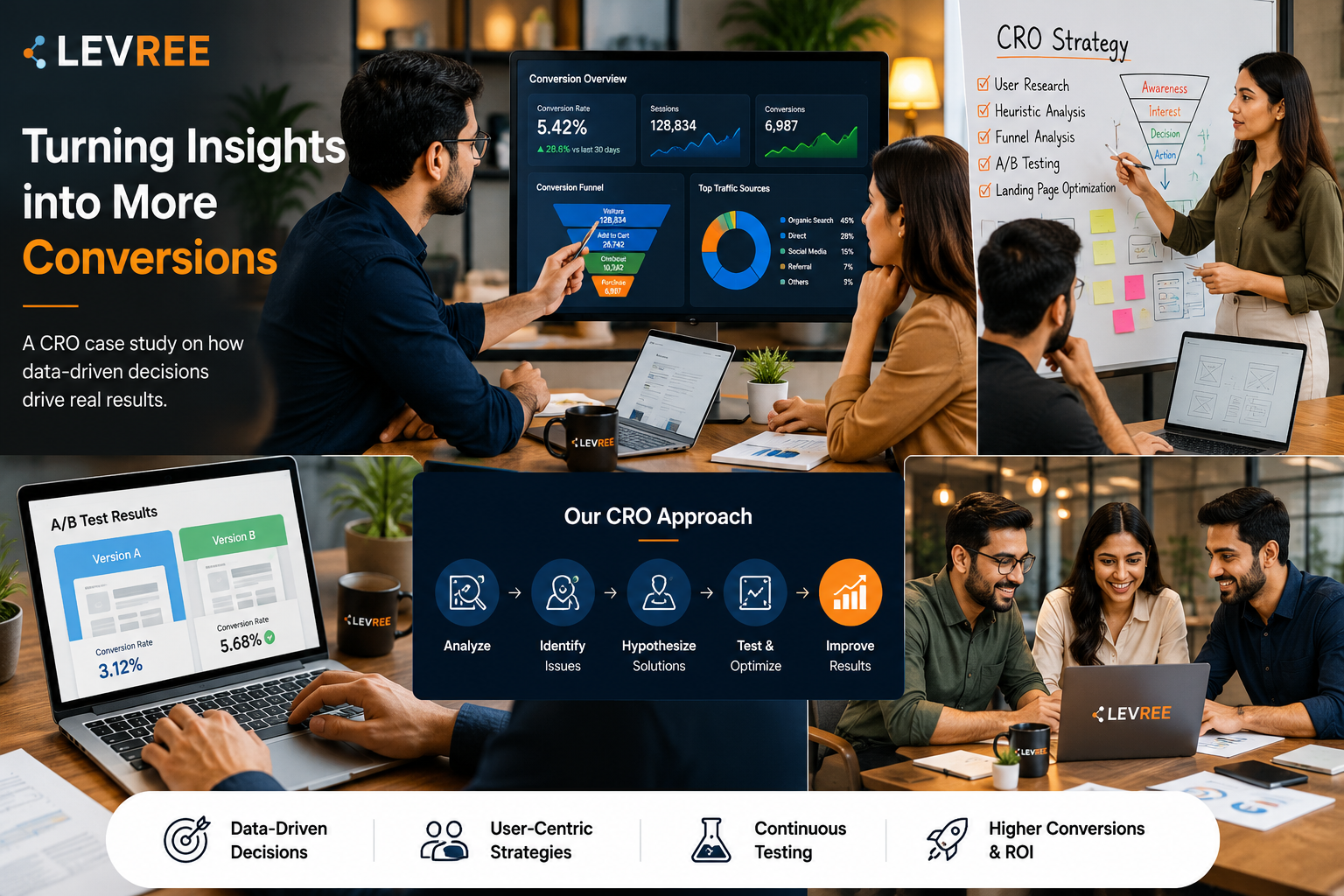
Find out why most conversion rate optimization efforts fail and what actually works. Levree shares proven CRO techniques.
In today’s competitive digital landscape, Conversion Rate Optimization (CRO) is a top priority for ecommerce and service-based businesses. Brands pour resources into A/B testing, landing page redesigns, form optimization, and button tweaks — yet many continue to see stagnant or disappointing conversions.
At Levree, we’ve analyzed dozens of underperforming funnels. The pattern is clear: most CRO efforts fail because they focus on surface-level tactics instead of addressing the deeper behavioral psychology driving user decisions.
This case study breaks down why traditional CRO approaches fall short and reveals how integrating behavioral psychology with smart funnel architecture delivers sustainable, profitable growth.
The Common Scenario: High Traffic, Low Conversions
One of our recent clients — an established service business — was investing heavily in paid advertising. Traffic metrics looked promising:
- Strong click-through rates
- Solid ad performance
- Growing visitor numbers
Yet the business outcomes were concerning:
- Rising Cost Per Lead (CPL)
- Declining Return on Ad Spend (ROAS)
- High bounce rates
- Poor lead quality
- Flat conversion rates
Their internal team doubled down on testing: new headlines, button color changes, shorter forms, and layout adjustments. After dozens of tests, results remained marginal.
The core issue wasn’t traffic volume — it was a broken conversion architecture misaligned with human psychology.
Why Surface-Level CRO Usually Fails
Most companies treat CRO as a tactical overlay on their marketing. They optimize isolated elements while ignoring the psychological journey users experience.
A full funnel audit with this client revealed several critical issues:
- Message-Match Breakdown: Ads promised speed, simplicity, and premium transformation, but the landing page used generic, corporate language that broke the emotional connection.
- Psychological Friction & Cognitive Dissonance: Users felt immediate confusion and distrust due to inconsistent messaging.
- Misaligned Expectations: The offer didn’t align with user intent across the full customer journey.
Brands often blame weak CTAs or poor design when the real problem lies in deeper structural and psychological misalignment.
Beyond A/B Testing: The Behavioral Psychology Foundations of Effective CRO
At Levree, we view testing as just one tool — not the strategy itself. True optimization requires understanding the human mind.
Key psychological principles we apply include:
- Cognitive Load & Hick’s Law: Too many choices paralyze decision-making. Simplifying options reduces mental friction.
- Loss Aversion: People hate losing more than they enjoy gaining. Framing offers around what users stand to lose is far more compelling.
- Social Proof & Authority: Humans look to others when uncertain.
- Consistency Principle & Micro-Commitments: Small commitments build momentum toward bigger actions.
- Message-Match & Expectation Alignment: Consistency from ad to website prevents cognitive dissonance.
- Anchoring: First impressions of value heavily influence perception.
Without these foundations, even advanced A/B tests produce weak or misleading results.
How We Fixed This Client’s Conversion System Using Behavioral Psychology
We rebuilt the funnel around how people actually think, trust, and decide:
1. Rebuilding Message Consistency We aligned the emotional tone, language, and promised benefits from ads through to the landing page and beyond. This eliminated psychological disconnect and significantly reduced bounce rates.
2. Strategic Friction Management Instead of removing all friction, we introduced intentional, smart friction through qualification questions and clearer expectation setting. Behavioral psychology shows that strategic friction improves lead quality for premium offers by filtering low-intent users while signaling value.
3. Implementing Micro-Commitments We added progressive psychological steps:
- Interactive assessments
- Value-first content opt-ins
- Low-pressure engagement triggers
These built consistency and momentum, making the final conversion feel natural rather than forced.
4. Psychology-First Data Analysis We combined quantitative data (heatmaps, session recordings, analytics) with qualitative behavioral insights to pinpoint where trust broke down, emotional triggers were missing, and decision paralysis occurred.
Measurable Results After Psychology-Driven Optimization
The structural changes delivered strong outcomes:
- Significant reduction in bounce rates
- Substantially higher lead quality and sales close rates
- Improved ROAS and lower customer acquisition costs
- More consistent, predictable conversion performance
- Sustainable growth that no longer depended on endless testing
Key Takeaways: What Actually Works in CRO
- Traffic is rarely the main problem — Most businesses need a better conversion system rooted in psychology.
- Architecture beats tactics — Fix the behavioral foundation before optimizing individual elements.
- Message consistency builds trust — Every step should feel like a natural continuation of the user’s journey.
- Strategic friction can improve results — Eliminating all resistance often reduces lead quality.
- Human psychology outperforms data alone — Understanding why users drop off is more powerful than simply knowing where they drop off.
Ready to Build a Psychology-Driven Conversion System?
Most businesses don’t need more traffic or more tests. They need funnels designed around how people actually make decisions.
At Levree, we specialize in combining behavioral psychology with proven funnel engineering to create high-converting experiences that drive sustainable revenue growth.
If your traffic is healthy but conversions are stuck, it’s time for a better approach.
Book a free CRO strategy session with our team today and discover how behavioral psychology can transform your results.
Let’s build a funnel that doesn’t just look better — it works with human nature.


Leave a comment
Your email address will not be published. Required fields are marked *