


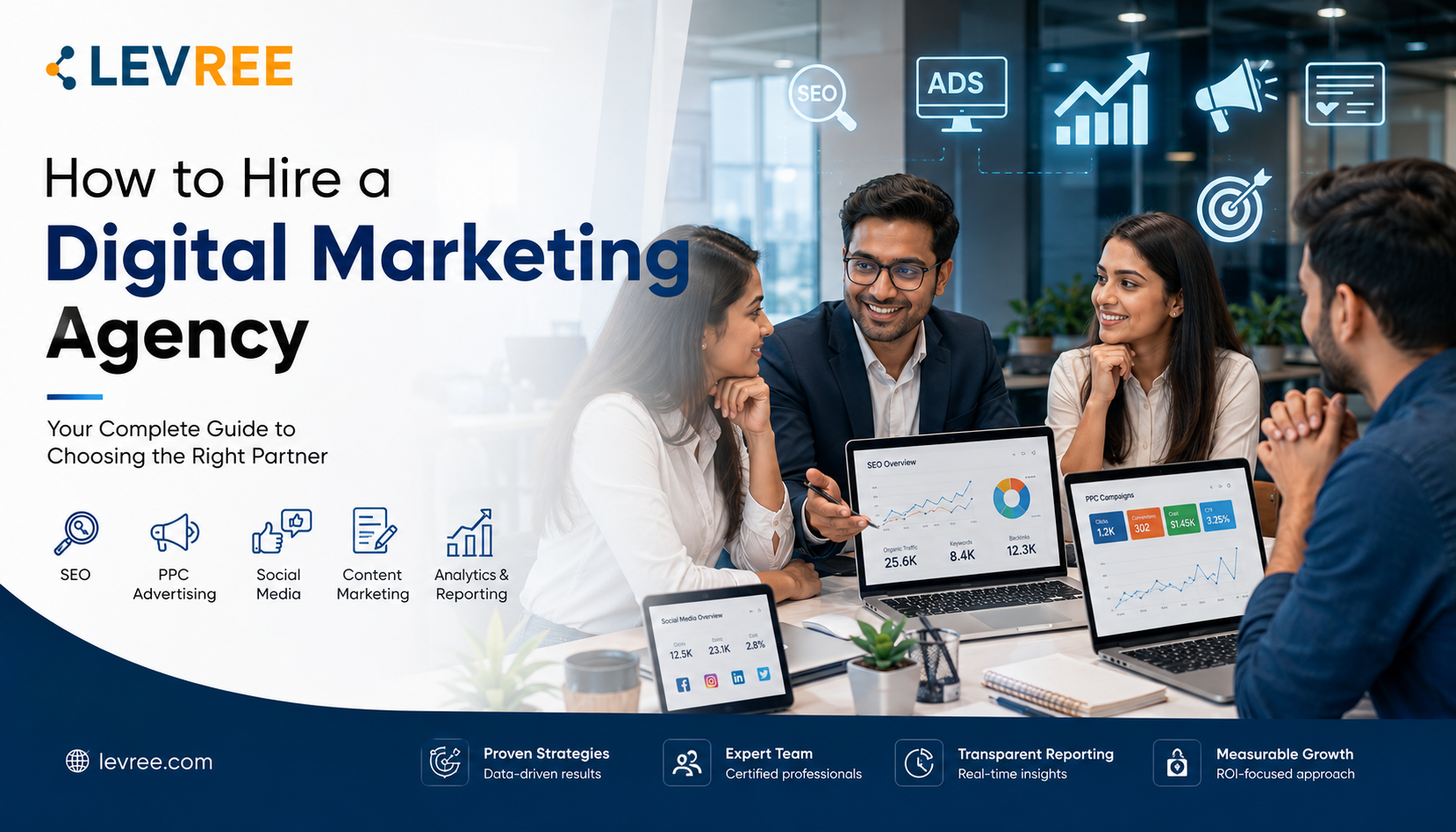
Not all digital marketing agencies deliver results. Learn exactly how to vet, compare, and hire the right agency — so your budget drives real business growth.
You've decided it's time to bring in outside help. Your in-house team is stretched thin, the competition is outranking you, and you know your digital presence could be doing more work. So you start Googling agencies — and immediately run into 47 options, all claiming to "skyrocket your growth" and "deliver measurable ROI."
Here's the problem: most of them will burn your budget and underdeliver.
Hiring the wrong digital marketing agency is one of the most expensive mistakes a growing business can make. Wasted spend, lost time, missed opportunities. Getting it right, on the other hand, compounds — the right agency doesn't just run campaigns, they become an extension of your growth team.
This guide walks you through exactly how to hire a digital marketing agency — with the questions to ask, the red flags to spot, and the process that separates great partnerships from expensive regrets.
What Does a Digital Marketing Agency Actually Do?
Before you evaluate anyone, get clear on what you're buying.
A full-service digital marketing agency typically covers some or all of the following:
- Search Engine Optimization (SEO): Ranking your site higher on Google to drive organic traffic
- Paid Advertising (PPC): Google Ads, Meta Ads, LinkedIn Ads — running campaigns that convert
- Content Development: Blog posts, landing pages, email sequences, and content strategy
- Social Media Marketing: Building brand presence and community across platforms
- Creative Production: Ad creative, graphic design, video content
- Web Development: Building or optimizing your website to support marketing goals
- Analytics and Reporting: Tracking what's working and refining based on data
Some agencies do all of this. Others specialize. Knowing which services you need determines which agencies belong on your shortlist.
Step 1: Define What You Actually Need
The biggest mistake businesses make is approaching agencies with a vague ask: "We need more leads" or "We want to grow online." That's like walking into a pharmacy and saying "make me healthier."
Before you talk to a single agency, answer these questions:
What's your primary goal?
- Increase organic traffic?
- Generate more qualified leads?
- Improve brand awareness in a new market?
- Launch a new product or service?
What channels matter most? Your B2B SaaS company and your local bakery need very different marketing mixes. Know whether you need SEO, paid ads, email, social, or a combination before you start comparing agencies.
What's your timeline? SEO takes 3–6 months to show meaningful results. Paid ads can generate leads in days. If you need fast results, your agency selection (and budget) should reflect that.
What's your budget range? Be realistic. Quality digital marketing from a reputable agency typically starts at $1,500–$3,000/month for focused services, and scales from there for comprehensive programs. Agencies that promise transformational results for $300/month are selling you something.
Step 2: Understand the Different Types of Agencies
Not all agencies are built the same. Matching agency type to your needs saves you months of misalignment.
Full-service agencies handle everything from strategy to execution across all digital channels. Best for businesses that want a single partner covering their entire digital presence. Levree, for instance, offers a 360° approach covering digital marketing, creative production, SEO, content development, web development, and video editing — so strategy and execution stay aligned under one roof.
Specialist agencies focus on one channel: SEO-only, paid ads-only, or email marketing-only. Best when you have a specific, well-defined need and an internal team handling the rest.
Boutique agencies are small teams (often 5–15 people) offering high-touch, custom work. Best for businesses that want senior attention on their account rather than being handed off to junior staff.
Large agencies have deep resources and broad capabilities but often come with higher retainers and less personalized service. Best for enterprise companies with complex, multi-market needs.
There's no objectively best type — only the best fit for your situation.
Step 3: Build a Shortlist of 3–5 Agencies
Don't evaluate 15 agencies. You'll exhaust yourself and end up choosing based on who submitted the flashiest deck rather than who's actually the best fit.
Where to find good candidates:
- Google search for agencies specializing in your industry or service need
- Ask peers, founders, or colleagues for referrals — warm introductions reveal things a website won't
- Check directories like Clutch, G2, or Agency Spotter for verified reviews
- Look at who's ranking well organically for competitive terms in your space — if an SEO agency can rank themselves, they can likely rank you
Initial filter criteria:
- Do they have case studies in your industry or with businesses at your scale?
- Do they list services that match your primary needs?
- Does their own website and content reflect the quality you'd expect them to produce for you?
That last one matters more than people realize. An agency with a poorly written, low-ranking website is telling you something about what they'll deliver.
Step 4: Evaluate Each Agency — The Right Questions to Ask
Once you have your shortlist, request discovery calls or proposals. Come prepared with the following questions. The answers (and non-answers) will tell you everything.
On Strategy and Approach
- "Walk me through how you'd approach our situation." A good agency asks questions before making recommendations. Be suspicious of anyone who pitches a solution before understanding your business.
- "What does your onboarding process look like?" Strong agencies have a documented process for learning your brand, goals, competitive landscape, and target audience before launching anything.
- "How do you stay current with algorithm changes and platform updates?" Digital marketing changes fast. Your agency should be actively adapting, not running playbooks from 2021.
On Results and Proof
- "Can you share case studies relevant to our industry?" Relevant case studies beat generic testimonials every time. You want evidence that they've solved a problem similar to yours.
- "What results did those clients achieve, and over what timeframe?" Push for specifics: traffic numbers, conversion rate improvements, cost-per-lead reductions. Vague claims like "significant growth" are a red flag.
- "Can we speak to a current client?" A confident agency will say yes immediately. Hesitation here is informative.
On Reporting and Communication
- "What does reporting look like, and how often do we meet?" At minimum: monthly performance reports and a standing call to review results. Better agencies proactively flag what's working, what isn't, and what they're adjusting.
- "Who will be our day-to-day contact?" Know whether you're getting a senior strategist or a junior account manager. The person on the call during the pitch is often not the person running your account afterward.
- "How do you handle underperformance?" Every campaign hits periods where results dip. You want to know how they diagnose problems and adjust course — not just spin bad news.
On Contracts and Pricing
- "What's your contract structure?" Month-to-month engagements offer flexibility but some agencies discount for 6- or 12-month commitments. Understand what you're agreeing to.
- "What's included, and what's billed separately?" Ad spend, design work, additional landing pages — know upfront what falls outside your retainer.
- "What happens if we want to exit the contract?" Ask this before you sign, not after.
Step 5: Spot the Red Flags
Some agencies are very good at selling. Fewer are very good at delivering. Here's what to watch for.
They guarantee specific rankings or results. No legitimate agency guarantees a #1 Google ranking or a specific ROAS. Algorithms change. Markets shift. Anyone promising exact outcomes is either lying or doesn't understand what they're selling.
They're vague about strategy. If they can't explain, in plain language, what they'll actually do and why, they don't have a real strategy. "We'll optimize your digital presence" is not a plan.
They pitch before they listen. The best agencies spend the first meeting asking questions, not presenting solutions. If you're getting a pitch deck on the first call before they understand your business, that's how they'll handle your campaigns too.
There's no transparency on who does the work. Some agencies outsource execution to offshore freelancers while charging premium rates. Ask directly who produces the work and where your account managers are based.
They lead with jargon. Impressions, CTR, EBITDA impact, synergistic content ecosystems — if they can't translate performance into business outcomes you care about (leads, revenue, customers), the reporting will frustrate you.
You can't find proof of their own marketing performance. Check their blog, social channels, and Google rankings. If they can't market themselves, why would you trust them to market you?
Step 6: Review the Proposal — What Good Looks Like
A strong agency proposal includes:
- A clear articulation of your goals and challenges (showing they listened)
- A recommended strategy with reasoning — not just a services list
- Realistic timelines and what to expect at 30, 60, and 90 days
- Transparent pricing with deliverables clearly defined
- Relevant case studies or examples
A weak proposal includes:
- Cookie-cutter templates with your logo dropped in
- Vague deliverables ("social media management" without detail)
- Results guaranteed upfront
- Heavy on services sold, light on strategy
Step 7: Start Small, Then Scale
Even with thorough vetting, the first few months with a new agency are a discovery period. A few practices that protect you:
Start with a defined pilot project if possible — a 90-day SEO engagement or a single paid campaign before committing to a full retainer. This lets you evaluate execution quality before you're locked in.
Set clear KPIs before the work begins. Agree on what success looks like: organic traffic growth targets, cost-per-lead benchmarks, conversion rate goals. If KPIs aren't defined upfront, agencies can always find a metric that looks good in the report.
Build a rhythm early. Weekly check-ins during onboarding, monthly strategic reviews, quarterly planning. The best agency relationships feel collaborative, not transactional.
Give it enough time. Digital marketing — especially SEO and content — takes time to compound. Don't pull the plug after six weeks because you haven't seen results. If you set realistic timelines at the start, hold to them. If an agency promised results in 30 days, that's on them.
What to Expect in the First 90 Days
Month 1 — Discovery and setup. Onboarding, audits, strategy development, account access, baseline metrics. Expect questions, not results yet.
Month 2 — Launch and early data. Campaigns launch. Early performance data starts coming in. Your agency begins adjusting based on initial signals.
Month 3 — Refinement and momentum. You start seeing directional results. Budget allocation gets refined. A pattern of what's working emerges.
Full momentum typically takes 4–6 months for SEO, 2–3 months for paid ads, and 6–12 months for content marketing to show compounding returns.
The Short Version: Your Hiring Checklist
Before signing with any digital marketing agency, confirm:
- [ ] They understand your industry and have relevant case studies
- [ ] They listened before pitching — and asked smart questions
- [ ] They can explain their strategy in plain language
- [ ] Reporting cadence and KPIs are agreed upfront
- [ ] You know exactly who will work on your account
- [ ] Contract terms, exit clauses, and pricing are transparent
- [ ] Their own marketing reflects the quality they promise you
Ready to Grow? Let's Talk.
At Levree, we help brands grow through creative strategy, data-driven campaigns, and digital execution that actually connects with people. From SEO and content to paid ads and creative production — we build full-stack digital ecosystems designed around your business goals, not generic deliverables.
We work with startups and established brands at every stage. Discovery calls are free, and we don't pitch before we listen.
Levree is a full-service digital marketing agency based in Dhaka, offering digital marketing, SEO, web development, video editing, content development, and creative production services globally.


Leave a comment
Your email address will not be published. Required fields are marked *