



Learn how to build a strong small business brand in Bangladesh with the right logo, brand identity, colors, messaging, and trademark strategy. This guide covers branding costs, DIY vs agency options, and practical steps to create a professional and trusted business presence.
Small business branding in Bangladesh is more competitive than ever, and in a crowded SME market, the businesses that grow aren't always the ones with the best product. They're often the ones that look and sound trustworthy from the first touchpoint. A customer scrolling through Facebook, walking past a storefront, or opening a WhatsApp message forms an impression within seconds, and that impression is shaped heavily by how your brand presents itself.
Many small business owners in Bangladesh treat branding as a one-time logo purchase. They commission a design, post it on their Facebook page, and move on. But a logo is not a brand. A brand is a system, and without the system, recognition doesn't build over time. You end up re-establishing credibility with every new customer instead of letting your reputation do the work. Each consistent touchpoint reduces the decision friction the next customer faces, which is why starting the system early matters.
This guide covers the practical steps to build a brand identity from scratch: what it actually includes, what each element costs in 2026, how to choose the right help, and when to protect your name legally. By the end of this article, you'll know exactly what to do and what to budget.
What brand identity actually means for a small business in Bangladesh
Why a logo alone doesn't make a brand
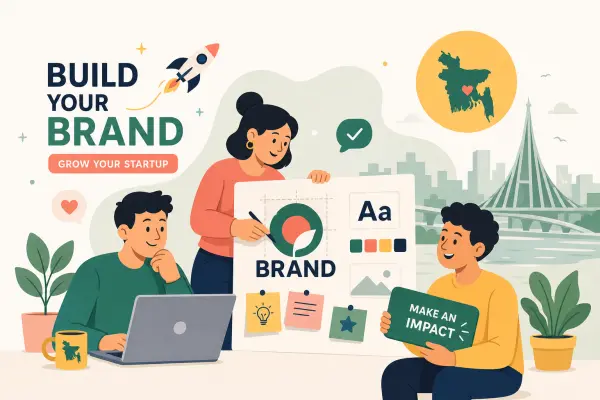
A logo is a mark. A brand identity is the full system around that mark, colors, typography, tone of voice, messaging, visual rules, and how all of it applies consistently across every customer touchpoint. The difference matters enormously in practice. Picture two biryani shops side by side. One has a consistent look, a recognizable name treatment, and a clear tagline on its signboard, Facebook page, and packaging. The other has a beautifully designed logo but no visual consistency anywhere else. Which one feels more trustworthy? The answer is obvious, and your customers make the same call about your business every day.
Brand identity is what customers feel before they buy. It signals quality, reliability, and professionalism before a single word of product description is read. In a market where buying decisions happen fast and competition is visible on the same screen, that feeling is a genuine competitive asset.
Small business branding in Bangladesh: brand identity checklist
At its core, a brand identity system for a Bangladeshi SME should cover your logo and its variations (horizontal, stacked, icon-only), a defined color palette, a set typography pairing, a brand voice guide, an imagery style, and a usage document that tells anyone working with your brand exactly how to apply all of the above. This document is your brand guide, the reference that makes your brand reproducible across people and platforms.
For businesses selling simultaneously on Facebook, WhatsApp, and Daraz, visual consistency across all three platforms is the real competitive advantage. When your Facebook cover, your WhatsApp product catalogue photo, and your Daraz listing all look like they come from the same place, you're building cumulative recognition. That recognition is what turns a first-time visitor into a buyer, and a buyer into a repeat customer.
Logo design and color psychology: getting the visual foundation right
How to choose a logo that works across every channel
The most common mistake Bangladeshi SMEs make with logo design is choosing complexity over clarity. An overly detailed illustration looks fine on a billboard but becomes unreadable as a Facebook profile picture or a WhatsApp avatar. Your logo needs to work at small sizes on mobile screens first, because that's where most of your customers will see it. Brief your designer on three things: whether you want a wordmark (just the business name), an icon mark (a symbol), or a combination of both; how the logo should read in both color and black-and-white; and what it should communicate about your positioning.
A professional logo from a credible local designer or agency in Bangladesh currently ranges from BDT 10,000 to BDT 50,000 depending on scope and revision rounds (as of 2026). The cheaper end of that range usually means a freelancer with a strong portfolio. The higher end means agency-level work with a strategic brief, multiple concept directions, and proper file delivery.
Color psychology and what it signals to Bangladeshi buyers
Colors carry meaning, and those associations are consistent enough in the Bangladeshi and South Asian consumer context to treat as a real strategic input. Red signals celebration, energy, and urgency, which is why it works well for food, promotions, and high-energy lifestyle brands. Blue signals trust, reliability, and modernity, making it a strong default for finance, healthcare, and technology businesses. Green carries associations with health, growth, and nature, which maps well to wellness, agriculture, and eco-conscious positioning. These are culturally informed generalizations rather than universal rules, but they're consistent enough to guide early decisions. Gold adds a premium, aspirational quality when used sparingly.
Pick two or three colors maximum and use them consistently everywhere, from your logo to your social media templates to your physical packaging. Don't choose colors based on personal preference alone. The question to ask is: what does this color communicate to my target customer in the context of my industry?
Building a brand voice that sounds like a real business
What brand voice means and why it matters for SMEs
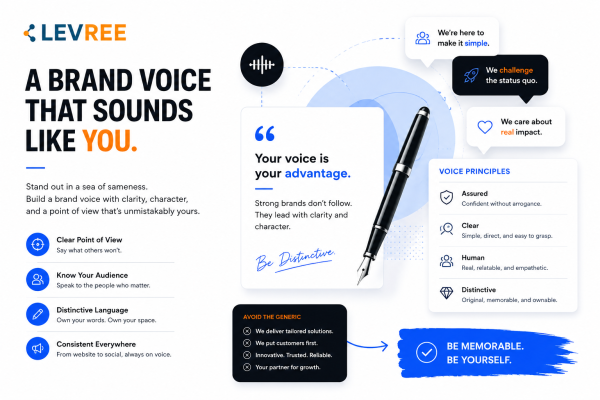
Brand voice is how your business talks, writes, and communicates across every surface: your Facebook captions, your WhatsApp replies, your website copy, and the text on your product packaging. It's one of the most overlooked components of a brand identity, and also one of the most damaging when it's inconsistent. If your social posts sound casual and playful but your website reads like a legal document, customers notice the disconnect even if they can't name it. That friction erodes trust.
In a market where customer relationships are built heavily through direct message conversations, voice matters as much as visual identity. A clothing brand and a medical clinic will have very different voices, but both need to sound like a real, coherent entity rather than a collection of random communications.
How to define your brand voice in one afternoon
A simple three-part framework works for most Bangladeshi SMEs. First, choose three adjectives that describe your brand's personality, for example: professional, warm, and direct. Second, write a one-paragraph description of your audience and what they care about. Third, write a short list of dos and don'ts for your tone, something like: "We use Bangla terms naturally in captions but write product descriptions primarily in English for clarity." That last point matters because the best-performing brand voice for most Bangladeshi SMEs uses a Bangla-dominant approach for mass-market content and a Bangla-English mix for urban, professional, or B2B audiences. For practical guidance on adjusting voice across markets, see how to adapt your tone of voice for new markets.
This document becomes the reference point for anyone who posts, writes, or communicates on behalf of your business, whether that's you, a social media manager, or a content team. Consistency at scale only happens when the rules are written down. Without that document, every new person who touches your brand introduces small inconsistencies that accumulate into a muddled identity over time.
The real cost of small business branding in Bangladesh
What each budget tier actually gets you
At the lean freelancer tier, BDT 15,000 to 30,000 typically gets you a logo, a basic color palette, and one or two social media templates. This works for a brand-new micro business that needs something professional to start with, but it comes with limited strategic input and usually one concept direction.
The standard small business package, priced between BDT 30,000 and 60,000, covers a logo, color palette, typography, a basic brand guide, a social media kit, and sometimes a simple landing page. As of 2026, this range represents the practical sweet spot for most Bangladeshi SMEs, enough of a system to apply consistently without overcommitting budget at an early stage. The premium agency package, from BDT 60,000 to 120,000 and above, delivers a full brand identity system, comprehensive guidelines, a website, campaign-ready assets, and strategic positioning work. Many businesses that invest at this level report better outcomes because higher execution quality reduces rework and the need to rebuild assets later. For a detailed breakdown of typical branding expenses, see this branding cost guide.
When DIY branding makes sense and when it doesn't
DIY branding is a reasonable choice at the very earliest pre-revenue stage, when you have a strong design sense and are using accessible tools like Canva to build basic consistency. It fails when you're entering a competitive market, seeking investors, or need to look credible to enterprise clients or healthcare patients. A Canva-built brand signals a certain level of commitment to your customers, and in some industries, that signal works against you.
At some point, you need professional help. The real question is how to make sure that investment is coherent, one integrated effort rather than scattered spend across four separate vendors who have never spoken to each other.
Choosing a branding partner that actually delivers
What to look for in a branding agency in Bangladesh
When evaluating agencies, look for a portfolio relevant to your industry, evidence of results not just aesthetics, and clarity about whether they handle strategy and execution together or just deliver design files. Agencies like Catch Bangladesh and Musemind have Clutch profiles with client reviews and competitive pricing signals. Options like Fibo Studio and BRANDING-LY appear at lower entry points on agency directories and suit businesses with tighter initial budgets. These are all legitimate starting points depending on your scope and timeline.
The hidden cost that most SME owners underestimate is the coordination overhead of piecing together a logo designer, a copywriter, a web developer, and a social media designer as separate freelancers. Each vendor works on their own timeline. Inconsistencies slip in between deliverables. Rework adds up. The result is a brand that looks like it was built by four different people, because it was.
Why a full-service agency like Levree changes the math
Instead of managing four freelancers across four timelines, a full-service agency like Levree handles logo design, brand guidelines, brand voice, website, and content assets as one integrated project, one brief, one point of contact, and one consistent output across every touchpoint. For Bangladeshi small businesses that need to move fast and look credible from day one, that integration removes the friction that kills most DIY or fragmented branding efforts.
Levree builds full-stack digital ecosystems specifically for Bangladeshi brands, combining creative strategy, data-driven execution, and AI-powered content production under one roof. If you want a cohesive brand identity built from the ground up without the overhead of managing multiple vendors, understanding what Levree offers is a practical starting point.
Trademark basics every Bangladeshi small business owner should know
How trademark registration works in Bangladesh
Trademark registration in Bangladesh is handled by the Department of Patents, Designs and Trademarks (DPDT). The process runs from filing through examination (typically three to twelve months), publication in the Trademark Journal, a sixty-day opposition window, and then the issuance of a registration certificate. The practical end-to-end timeline from filing to certificate is twelve to twenty-four months depending on examination workload and whether any opposition is filed. Bangladesh uses the Nice Classification system, and single-class applications are accepted. Local firms can help you navigate filings and paperwork; consider consulting a provider that offers specialized trademark services in Bangladesh.
What it costs and when you actually need it
The current government fee structure for a single-class filing at the DPDT includes a filing fee of BDT 5,000, a publication fee of BDT 3,000, and a registration fee of BDT 20,000, all subject to 15% VAT. Total government fees for a straightforward single-class registration sit around BDT 28,000 plus VAT, manageable for most SMEs when planned as part of the overall brand investment. The registration term is seven years from the filing date and is renewable.
The practical trigger for filing is straightforward: if your brand name is gaining traction, you're actively investing in marketing, or a competitor could plausibly copy your name, register now rather than after a conflict arises. Recovering a brand name after someone else files it is expensive, slow, and often unsuccessful. Filing early is cheap by comparison.
Putting it all together
Small business branding in Bangladesh isn't a luxury. It's the foundation that makes every marketing taka work harder. A well-built brand identity means your Facebook ads carry more recognition, your SEO content builds more authority, and your customer referrals convert more reliably because the business looks like what it is: credible and consistent.
The core action sequence is straightforward: define your brand identity system first (logo, colors, voice), apply it consistently across every channel, understand what professional help costs before deciding whether to DIY or hire, and protect your name through trademark registration once traction is real. For Bangladeshi small businesses that want to move fast without the overhead of managing multiple vendors, a full-service agency that handles branding end-to-end is often the most efficient path forward.
Start with one concrete step this week. A defined color palette, a written voice guide, or a logo quote from a local agency, any one of these moves your brand from an idea into a system. The earlier you build that system, the more every subsequent marketing investment benefits from it.

Leave a comment
Your email address will not be published. Required fields are marked *