


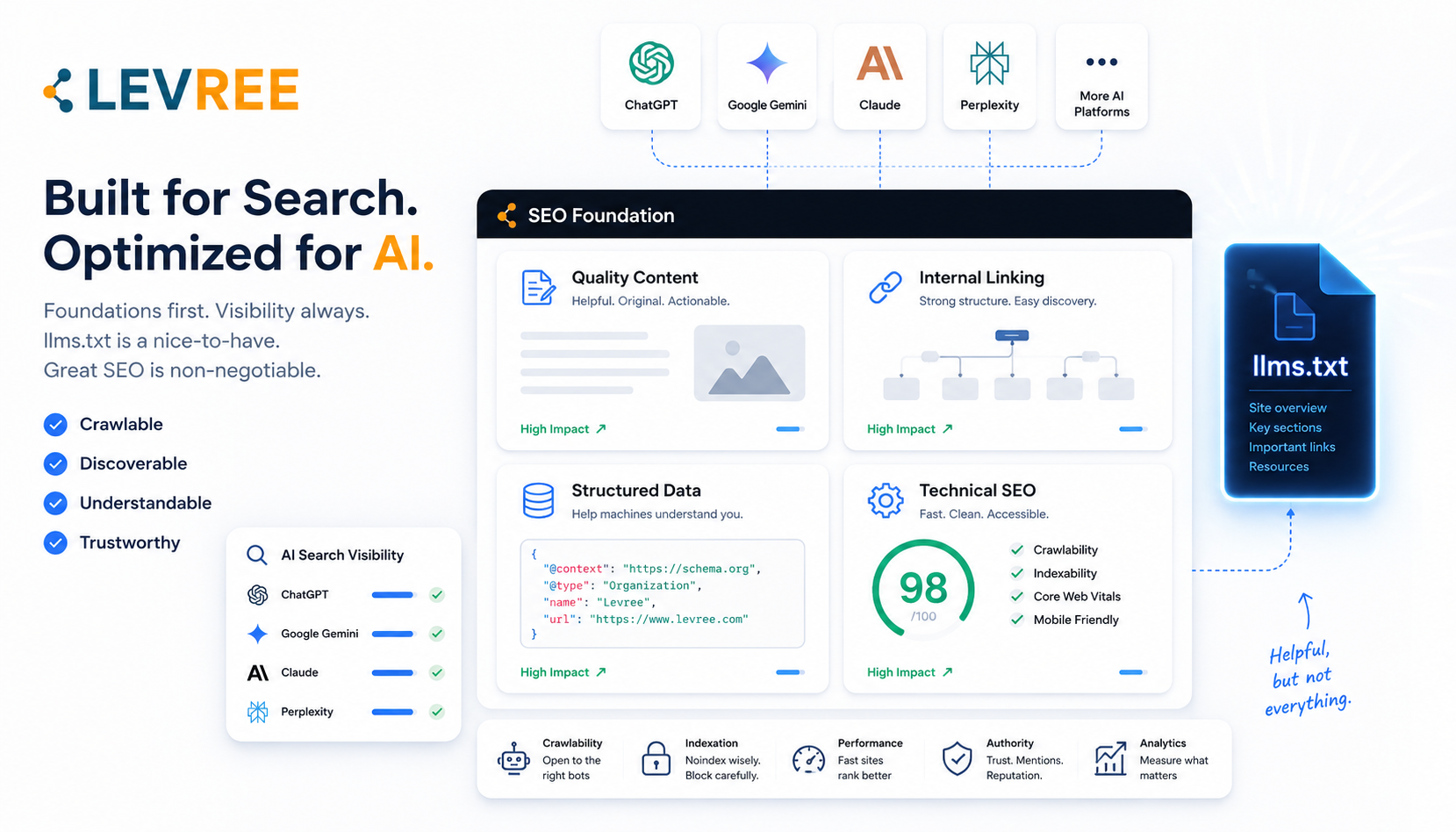
Everyone’s talking about llms.txt as the next big thing in AI search optimization. But does it actually improve visibility in ChatGPT, Gemini, or AI Overviews? Here’s Levree’s practical take on what matters, what’s hype, and what businesses should prioritize first.
Does llms.txt Actually Matter? What’s Hype, What’s Useful, and What to Fix First
AI search is evolving fast. Between Google AI Overviews, ChatGPT, Gemini, Claude, and whatever arrives next, businesses are scrambling to stay visible in a search landscape that suddenly feels fragmented.
And whenever the industry gets nervous, a new “must-have” technical file tends to appear.
First it was robots.txt.
Then sitemap.xml.
Now everyone’s talking about llms.txt.
At Levree, we’ve seen the same question popping up repeatedly:
“Do we need llms.txt for AI SEO?”
The short answer?
Maybe. But probably not for the reasons people think.
Before businesses rush to generate another file for their website, it’s important to understand what llms.txt actually does, what it doesn’t do, and why foundational SEO still matters far more.
First, What Is llms.txt?
llms.txt is a proposed standard introduced in 2024 that aims to help large language models better understand website content. The idea is fairly simple:
You place a markdown file at:
/llms.txtThis file acts like a curated guide to your website. Instead of relying solely on navigation menus, category pages, or complex site structures, AI systems can theoretically use the file to identify:
- What your site is about
- Which pages matter most
- Important resources
- Products or services
- Documentation and knowledge hubs
Think of it less like a crawler directive and more like a simplified map for AI systems.
That distinction matters.
Unlike robots.txt, llms.txt is not designed to control access.
Unlike a sitemap, it’s not primarily for discovery.
And unlike structured data, it’s not machine-readable schema markup.
It’s closer to a clean, human-readable summary layer.
So… Does llms.txt Actually Matter?
Yes — but not as a magic SEO shortcut.
Right now, llms.txt matters more as an emerging convention than a proven ranking factor or AI visibility lever.
That’s where much of the online hype gets things wrong.
Some marketers are already positioning llms.txt as:
- the future of AI SEO
- the key to appearing in ChatGPT
- a replacement for technical SEO
- an “AI indexing switch”
There’s currently no strong evidence supporting those claims.
Most major AI platforms still publicly rely on existing web standards and crawler systems for discovery and content access.
That means:
- crawlability still matters
- structured data still matters
- internal linking still matters
- quality content still matters
And honestly? Those fundamentals are doing most of the heavy lifting.
What the AI Platforms Actually Say
One of the biggest mistakes businesses make is listening to hype before checking platform documentation.
Here’s what the major players are actually documenting today.
OpenAI
OpenAI explains that publishers who want visibility in ChatGPT search experiences should ensure they aren’t blocking:
OAI-SearchBot
If publishers want to prevent content from being used for training, they can separately block:
GPTBot
That separation is important.
It means:
“Allow search access” and “block training usage” are now two different technical decisions.
Google has taken a similar approach.
Through:
Google-Extended- robots.txt controls
- structured data
- crawlability standards
…publishers can influence how content is accessed and used across Google Search and Gemini-related systems.
Notice what’s missing?
Google isn’t currently positioning llms.txt as a primary ranking or indexing mechanism.
And neither is OpenAI.
Where llms.txt Can Be Useful
Now, that doesn’t mean llms.txt is useless.
Far from it.
At Levree, we actually think it can provide real value — especially for websites with:
- large documentation libraries
- SaaS knowledge bases
- technical resources
- educational content
- extensive long-form publishing
But the value is often indirect.
Creating a good llms.txt file forces businesses to answer some useful questions:
What is our website actually about?
A surprising number of websites struggle to communicate this clearly.
Which pages genuinely matter?
Not every page deserves equal visibility.
Is our information architecture clean?
Messy navigation creates confusion for users and crawlers alike.
Are our most valuable resources easy to discover?
If your best content is buried deep within your site, that’s a bigger issue than missing llms.txt.
In many cases, the process of creating the file improves clarity across the entire website.
And that’s beneficial regardless of whether AI systems fully adopt the standard long-term.
What Businesses Should Fix First
Before generating llms.txt, there are several areas that deserve much higher priority.
1. Make Sure AI Crawlers Aren’t Accidentally Blocked
This sounds obvious.
Yet many websites unknowingly block important crawlers through outdated robots.txt rules or security configurations.
If you want visibility in AI-powered search experiences:
- don’t block relevant search crawlers
- understand the difference between indexing and training bots
- audit crawler permissions regularly
This is foundational.
Without access, AI systems can’t properly interpret or surface your content.
2. Improve Crawlability
Google has been saying this for years, and it still applies in AI search.
If your pages aren’t easy to crawl, discovery becomes harder.
Common crawlability issues include:
- broken internal links
- orphan pages
- excessive JavaScript rendering
- poor navigation structures
- hidden content
- weak site architecture
If your best case study is hidden three layers deep behind a JavaScript carousel, llms.txt isn’t going to save it.
3. Strengthen Internal Linking
Internal linking remains one of the most underrated SEO fundamentals.
Strong internal linking helps:
- search engines discover pages
- establish topical authority
- distribute page value
- improve user navigation
- clarify content relationships
AI systems also benefit from clearer contextual relationships between pages.
At Levree, we often see businesses obsess over emerging SEO trends while ignoring basic linking opportunities sitting right in front of them.
4. Use Structured Data Properly
Structured data still plays a massive role in helping machines understand content.
Schema markup helps search systems interpret:
- articles
- products
- organizations
- FAQs
- services
- reviews
- authorship
- events
Weak or inconsistent schema creates ambiguity.
And ambiguity is the enemy of visibility.
Before experimenting with speculative AI optimization tactics, businesses should ensure their structured data implementation is clean and complete.
5. Fix Indexation Problems
One of the most common technical SEO issues is conflicting indexation signals.
Examples include:
- pages blocked in robots.txt but indexed elsewhere
- accidental noindex tags
- duplicate URLs
- canonicals pointing incorrectly
- staging environments being indexed
- crawl traps
These issues can severely impact discoverability.
And they matter far more than whether you have an llms.txt file.
6. Publish Better Content
This is still the biggest differentiator.
AI systems and search engines both reward:
- clarity
- originality
- expertise
- evidence
- authority
- usefulness
If your content says exactly the same thing as every other generic industry article online, no technical file is going to make it stand out.
The websites most likely to earn citations, mentions, and visibility in AI systems are the ones publishing:
- genuinely useful insights
- original thinking
- proprietary data
- expert perspectives
- well-structured answers
Good technical SEO supports good content.
It doesn’t replace it.
Where Levree Stands on llms.txt
At Levree, we view llms.txt as a “nice-to-have” rather than a critical SEO requirement.
For the right websites, it’s:
- lightweight
- low-risk
- potentially useful
- easy to implement
And over time, adoption may increase.
But businesses shouldn’t mistake it for a shortcut to AI visibility.
The bigger priorities remain:
- crawlability
- technical SEO
- structured data
- indexation hygiene
- internal linking
- authoritative content
Those are still the foundations of discoverability — whether the search interface is Google, ChatGPT, Gemini, or something entirely new.
The Practical Takeaway
So, should you add llms.txt?
Probably yes — if your SEO foundations are already strong.
Should you expect dramatic improvements from it alone?
Probably not.
Right now, the evidence simply doesn’t support the hype.
The businesses that will win in AI search won’t be the ones chasing every shiny new file.
They’ll be the ones building:
- technically accessible websites
- high-quality content ecosystems
- strong topical authority
- trustworthy digital brands
llms.txt may eventually become a useful supporting layer.
But it’s not the engine.
The fundamentals still are.
FAQs
What is llms.txt?
llms.txt is a proposed file standard designed to help AI systems better understand and navigate website content.
Does llms.txt improve SEO rankings?
There’s currently no confirmed evidence that llms.txt directly improves rankings in Google or AI search systems.
Should businesses implement llms.txt?
If your technical SEO foundations are already strong, implementing llms.txt may provide additional clarity and future-proofing benefits.
Is llms.txt replacing robots.txt?
No. robots.txt controls crawler access, while llms.txt is intended more as a content guide or summary file.
What matters more than llms.txt?
Crawlability, structured data, internal linking, indexation, and high-quality content remain far more important.
Sources
- llmstxt.org proposal
- OpenAI publisher documentation
- Google Search Central documentation
- Google structured data guidelines
Adapted and rewritten for Levree from the original source content.

Leave a comment
Your email address will not be published. Required fields are marked *